Abstract: For this essay, we had to observe/join any online community of our choice and analyze the community’s behavior, demeanor, and interactions with one another. We were asked to write a paper evaluating trends and patterns of behavior, including primary or secondary sources.
Judgement in Online Communities: A study of r/AmItheAsshole
Imagine having an argument with a friend and instead of resolving it privately, you post the situation online and allow thousands of strangers to decide who’s right and who’s wrong. This is common in the r/AmItheAsshole community on Reddit. The subreddit, often referred to as AITA allows users to share personal conflicts and receive judgements from others using abbreviations such as “YTA” (You’re the Asshole) and “NTA” (Not the Asshole). According to its origin, it was created by Marc Beaulac after a dispute at his workplace, which led him to question if he was “mansplaining”, which inspired the idea of a space where people could seek outside judgement. The AITA community demonstrates how individuals often turn to online spaces for validation while also exposing how anonymity can encourage users to make blunt moral judgments. As a result, the subreddit becomes a space where strangers quickly assign moral labels based on limited information.
The subreddit was created in 2013 and has grown to over 24 million members. Because many users turn to this community for validation, the tone of responses is often direct and judgemental. From a broader perspective, commenters tend to be more confident about their moral judgements rather than asking clarifying questions. This pattern created an environment where agreement and reassurance are prioritized. For example, one commenter wrote, “The fact that you don’t use AI is probably obvious… your tag is poor taste. YTA.” The blunt phrasing of this response shows how users confidently judge individuals they don’t even know. Instead of offering unbiased advice, commenters tell their opinion as if it’s the conclusion to the problem. This kind of interaction encourages other people to follow the same tone, resulting in multiple comments that repeat similar judgements. As a result, the discussion shifts from looking at things from different perspectives to reinforcing a single narrative. This pattern suggests that participants are not only evaluating behavior but also contributing to a culture where validation shapes how conflicts are interpreted online.
When I first began observing r/AmItheAsshole, I expected the comments to be more balanced and discussion based. Instead, I noticed that many responses quickly jumped to a verdict. As I continued scrolling, I saw that the same abbreviations appeared, creating a predictable pattern. This repetition made the experience feel less like a conversation and more like a voting system. This structure turns serious situations into simplified groups of right or wrong. Rather than encouraging discussion, it encourages quick decision-making based on first impressions. Thus, emotional context is often minimized in favor of immediate judgement. Overtime, I realized that users were less focused on understanding each situation in depth and more focused on quick, decisive opinions.
One thing I noticed was that participants interact using anonymous usernames, which allows them to separate their real identities from their statements. Names such as “u/TrollHunter1962” and “u/No-Mathematician6921” do not reveal personal information, reinforcing the sense of privacy within the space. This anonymity also reflects the younger, internet-based demographic often associated with Reddit culture. This privacy gives people the comfortability to be blunter in their responses than they would in person. This connects to broader patterns of online behavior where secrecy lowers social accountability. Without face-to-face consequences, users may feel less pressure to watch their tone or consider emotional impact.
This pattern can also be observed across other social media platforms such as TikTok, where comment sections display similar blunt, straight-forward comments towards strangers. In both spaces, namelessness and lack of real-life consequences can encourage users to respond quickly without considering tone.
The interactions within r/AmItheAsshole made me reconsider what defines a community. As defined by Guild, an online community is where people come together digitally to interact, share knowledge, and build relationships. However, I have not consistently seen these qualities within the Reddit space. Instead of building relationships, users seem to focus on assigning labels and moving on to the next situation. In one post, a user asked whether he was wrong for being upset that his wife planned a weekend trip with friends right before his birthday, even though she offered to cancel. One response to this was:
“Good grief. How old are you? She offered to cancel but…not in the right, grovelling way? She can’t win, can she. You refused her offer to cancel. At this point, you’re determined to create your own misery. YTA.” – u/happybanana134
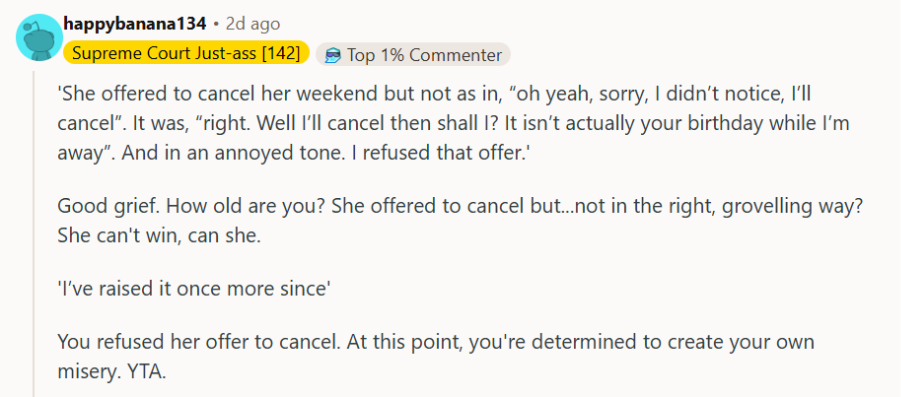
Although I may agree with the commenter’s conclusion, the tone is notably harsh and dismissive. Rather than offering a balanced perspective, this response automictically criticizes the user’s character. This kind of judgement contradicts the idea of an online community built on connection and interaction. Participants in the subreddit are typically strangers who interact briefly and then move on, without forming meaningful relationships. Even though users communicate with one another, the exchanges are temporary and centered around judging a single situation rather than building sense of belonging.
I also noticed how quickly users moved from one situation to another. After assigning a label such as “YTA” or “NTA”, many commenters do not return to the discussion. This creates a fast-paced environment where interactions are brief and temporary. Unlike traditional communitites where members build ongoing relationships, participation in this subreddit appears to be transactional. Users enter the conversation, state their opinion, and move on.
These observations raise important questions about why individuals turn to online communities for support and validation. Questions such as whether there is a breakdown in how people seek help from friends or family, and whether online communities are gradually replacing traditional support systems with these online tools. In some cases, platforms like r/AmItheAsshole may function as informal spaces for giving advice, where individuals feel more comfortable sharing personal situations anonymously. From a psychological perspective, John Suler’s online disinhibition effect suggests that individuals are more likely to express themselves in blunt or extreme ways online due to anonymity and reduced social consequences. However, this raises further questions about whether these interactions provide meaningful or lasting support, or if they mainly offer temporary validation. Overall, these patterns suggest a shift in how people communicate and seek reassurance through digital media, where anonymity and accessibility shape the way individuals express vulnerability and receive feedback.
Beyond these patterns of communication, it is important to consider why individuals choose to post in this community in the first place.
This need for reassurance is especially visible in posts labelled “WIBTAH” (Will I be the Asshole), where users ask whether they would be wrong before acting. In one “WIBTAH” post, one user questioned whether they should skip a friend’s birthday after the friend had taken food and drinks without permission. Although the situation had already been addressed privately, the user still turned to strangers online for reassurance before deciding. This pattern shows how individuals may already feel uncertain about their actions, yet they still seek some sort of approval to confirm their judgement. Posting online allows them to receive immediate feedback from a large audience, which can feel more accessible that discussing sensitive topics with professionals or the ones you are closest to.
This behavior reflects a broader shift in how people seek emotional support, where digital platforms are used as substitutes for advice. However, the organization of r/AmItheAsshole also comes with limitations. Users only receive one side to the story which means judgements are often based on biased, incomplete information. A lot of posts are written from the perspectives of the original author, who may intentionally or unintentionally present themselves in a more innocent way. This results in users coming to moral conclusions without the full context. In addition, because responses are usually short and immediate, there is limited space for deeper discussion or clarification. This shows how while the community can provide quick feedback, it does not always lead to thoughtful or well-rounded conclusions.
In conclusion, observing the AITA community left me with mixed feelings about how people use online communities. On one hand, these spaces can be helpful as they allow people to share experiences, receive feedback, and feel less alone in their conflicts. The anonymity of the platform may also make users more comfortable expressing vulnerability. However, that same anonymity can encourage blunt judgements which may be harmful. This made me question whether this trend reflects a positive shift in communication or a breakdown in traditional support systems, where people rely on friends and family. While this can provide a sense of clarity, it can become unhealthy if began to over rely on it. Overall, the subreddit demonstrated both the benefits and drawbacks of anonymous online interactions, leaving questions about how digital spaces are shaping the way people seek advice understand personal conflict.
Works Cited
“Am I the Asshole?” Reddit, www.reddit.com/r/AmItheAsshole/
Goodall, Michelle. “What is an online community?” Guild, 2002, What is an online community? A complete overview
Suler, John. “The Online Disinhibition Effect.” CyberPsychology & Behavior, vol, 7, no. 3, 2004, The online disinhibition effect

